Friday, August 17, 2012

Tips Tricks And Hints For A Successful Magic Performance

The art of performing magic as an entertainment art is exactly what it says, "performing". Therefore it is important that the budding magician has a good repertoire at his disposal and is ready to tackle most situations that may arise with a quickfire gag or alternative trick.

The purpose of this web page is to give you some pointers and ideas on how to structure your act and give you some useful phrases that you may wish to use, should the opportunity arise. The actual "Magic Trick" is still the focus of the performance but even a very simple trick can be greatly enhanced by a good performance from the magician. Don't forget that your audience have given up their time to watch you. Although they don't know how the tricks are done, they are willing to let you convince them that you can  successfully perform a miracle or magical feat, much the same convincing that people might get from viewing a good movie. This is your moment, polish it and enjoy the satisfaction of knowing that you have created an entertaining magic experience for your spectators.

Practice Practice Practice !!!

Why the repetition ??? . Quite simply, practice is the only surefire way that you can get your tricks up to a polished standard. It is not so much the difficulty or simplicity of the trick that counts, it is making sure that you are competent in performing it in front of an audience. It is embarrassing to forget a part of the magic trick half way through or to mess up the handling. Lots of practice should also enable you to chat away to your audience while performing and (importantly) not have to keep your eyes on the cards or trick, all through the performance. ( See paragraph on Misdirection, further down the page )

Structure

To assist the success of your magic act, you should try to structure your performance by planning your tricks so that one trick leads onto another, either by theme or by some story line that you may be telling..  Also make sure and save your strongest and most impressive tricks until the end of your act. This will prevent an anticlimax, as, if the audience were to view them before then, their expectations for the rest of the act would be of the same standard or higher.

Misdirection, Your Greatest Friend In Magic

The importance of misdirection incorporated into your act can not be stressed enough. Misdirection is the skill that can really elevate your act and give it the polish that it needs to have a really professional feel.
For the best entertainment value for your magic tricks it is important to learn to control everything going on during your performance. Factors include where your audience are positioned, where and when they look and what they are thinking about. Basically. misdirection is making sure that your audience say sufficiently entertained by your act to stay focused on the magic and don't get distracted enough to start trying to figure out how the trick is done. This is not usually a problem as more often than not, the audience are completely oblivious to the actual workings of the trick.

Incorporating misdirection into your act can be done physically with the use of props such as a magic wand or even tossing a coin into the air at the precise moment where you want the audiences focus of attention to be diverted. Even things as subtle as running your fingers through your hair ( or rubbing your scalp, if your are follicley challenged like me, can be enough as can drawing attention to a member of the audience with a cheeky comment to distract your guests without them realising this.

Time misdirection is another useful sleight in your arsenal. This is where you leave a little time to pass between the actual deception move and the final revelation. A classic example where time misdirection is successfully used is in the Cross Cut Force which is one of the simplest but most effective card forces there is. I have only touched on the subject of misdirection. It is an ongoing thing and is limited only by your creativity. Try and think of ways to incorporate it into your performance to get you on the road to success.

Clap Clap !!!

Applause is an important part of the success of a magic performance as it creates atmosphere, lets the magician know that they are appreciated and that the act is going successfully. Applause is something that should be earned and is a reward for a well performed act. The magician should be well practiced at their act so that it is sufficiently polished to run smoothly. Lack of practice, leading to a messed up performance or the magician forgetting their lines does not deserve applause.

Also do not take the word "applause" to automatically mean a hand clap. It can take the form of other audience reactions such as a gasp or a scream, showing that the audience has responded. This is more common in close up magic  and street magic. Some of these reactions can be seen on David Blaine's TV magic specials. Applause will not always happen automatically due to audience shyness or by them not being sure exactly when to clap. There are various means that you can use to encourage applause.

Stopping and looking briefly at your audience during your act can create a momentary pause that will usually trigger the audience into applauding. It is also feasible to have a friend(s) in the audience to start an applause at the correct times. Inviting members of the audience on stage should automatically generate applause and create added character into your act. Indeed, if it comes down to it, you can tell the audience when to clap. This should be done carefully either by using the clapping as part of the act or by cheeky patter which comes across in an entertaining manner. You will find some hints on patter in the chapters below.

To sum up applause, the bottom line is that it is a reward for a well rehearsed act and a job well done. It should not be taken for granted and the magician should find that if they have perfected their act well enough to genuinely earn the applause, that this should be an encouraging step for them

Erm, This Wasn't In The Script !!

There are times that things will not go 100% as planned. This is a fact of life and a successful act.will depend on the magician having some fast patter at hand, to make light of any mess-ups in the performance. This patter can often win over an audience who are usually quite forgiving, realizing that even magicians are human.

Likewise, you will occasionally come across "hecklers" ( the name given to someone in your audience who continually interrupts your act by shouting out distracting comments).
Here are a few ideas to use in your magic act

When Things Don't Go Exactly As Planned

Ladies and Gentlemen, when I arrived here tonight, I received a special request... but, I'm going to perform anyway.
"Man, its so quite in here, you could hear a career drop"
"Gee, that's weird, it worked perfectly in the magic store"
"That's the first time that ever happened again"
"It doesn't look as bad from my side"
"There is only one thing this magic trick is missing"
"Erm...could you step a little to the left? Your standing on the trapdoor."

Heckler Stoppers  ( These should be used carefully at your own discretion)

"He's so ugly that when he entered an ugly contest, they said "Sorry, no professionals allowed."
" Is that your own teeth or are you breaking them in for a donkey?"

Wednesday, August 1, 2012

The Secrets of Magic R&D

The letter W!hen I last appeared on this website, I was involved in the Great Designer Search 2 contest. A little over a year ago, I was in state of transition. I was trying to make a graceful exit from my career as a bookseller to the more creative field of animation (not reanimation, which is an entirely different thing!). When opportunity came knocking on my door, however, I put my plans aside and entered the contest. The winner would get a six-month paid internship working as a designer in Magic R&D.
I figured I would be eliminated quickly, but I would feel like a fool if I didn't at least try to get a job designing my favorite game. Instead, my work turned out to be the sort of thing that the judges were looking for and I took the shortest possible route into Magic design. It's good to have a plan in life, but it's also good to stay alert for opportunities that no one can plan for.

The structure of the contest required the participants to work with other designers over the Internet to create Magic sets of their own design. Each of the finalists took on the role of a set's lead designer for, providing the guiding vision of the set's identity. Other participants formed a loose team, designing cards to fit within the framework of that vision. The contestants went through a series of fiendishly difficult design challenges, with one person eliminated in each round. To make a long story short, I won the contest and was hired temporarily as a Magic design intern. Since that time, I have been hired as a full-time employee at Wizards if the Coast. I am profoundly grateful for the contributions of the talented amateur designers who spent their time helping me.

The Great Designer Search 2 was a great education in Magic design. I encourage all aspiring Magic designers to read the details of the coverage; it's the most concentrated draught of Magic design information available on the Internet. Of course, working with R&D on upcoming products is quite different from participating in the GDS2 in some respects. Now that I've been working here for a few months, I can reveal the Secrets of Magic R&D!

Modern Design Standards

Magic design is constantly evolving. R&D meets regularly to discuss how to adjust the color pie to make the colors distinct from each other, whether certain keywords are pulling their weight, and how much complexity is right at each rarity. Magic is naturally complex, and certain cards create more additional complexity than others. Over the last few years, we've been changing where players will most frequently encounter that complexity.


During the Designer Search, I was working based on some obsolete assumptions. Not only could I not see the next eight to twelve sets worth of innovation that were in the works, but I had to look back several years in order to get a clear picture of what sorts of standards existed in common between sets. It was already clear to me at that time that Time Spiral block was too complicated in some respects. So I decided to consider sets from Lorwyn onward to be my examples of modern Magic design. The comments from the judges during the contest and my own experiences working in R&D have confirmed that design practices have evolved considerably since Lorwyn.

Cards in Time Spiral block were overly complex on a card-by-card basis. Developer Tom LaPille uses Riftmarked Knight as a great example of cards that are excessively difficult to parse. Protection is a pretty complicated mechanic, an archaic holdover from the wild old days of Alpha. Flanking is a bit bizarre and unintuitive. Suspend is pretty hard to understand. This card has all three abilities. But wait! When it enters the battlefield from suspension, you get a token version of it that has the colors reversed! By the time Lorwyn block was being made, R&D had begun to understand that this sort of complexity had to be toned down if the game was to be accessible. But Lorwyn block revealed a different kind of complexity, one that couldn't be ascertained by looking at individual cards.


Creatures from Lorwyn block were easy to understand individually, but because nearly all of them had a relevant ability while sitting on the battlefield, they created what we call "on-board complexity." The profusion of choices became confusing for many players, which could lead to frustration when they made too many mistakes. Magic is already an extremely complex game, and the board states that frequently resulted in Lorwyn block Limited games were increasing that complexity to a degree that made the game inaccessible. Nowadays we try to include more "vanilla" creatures (ones with no rules text) and "virtual vanilla" creatures (ones that have an ability that triggers once when they enter the battlefield) in sets at common rarity. The complex game play that experienced players crave for Constructed play has been pushed to higher rarities, where new players are less likely to encounter it.

A lot of this complexity redistribution isn't very noticeable unless you know to look for it, but the other major innovation in design practices is much more obvious: increased resonance. A card that suggests a familiar concept is both appealing and easy to understand, even if the actual rules text of the card is wordier than usual. My favorite card in this category is Form of the Dragon. This card is pretty complicated and weird, but it tells a story: you have transformed into a dragon, and have all of the powers of a dragon. This makes it easier to understand. Designing cards that are analogous to concepts that players are already familiar with is a practice as old as Alpha, but these cards became increasingly rare for many years. The big push to include resonant tropes in recent sets began in the Magic 2010 core set and has culminated (so far!) in Innistrad.


The Design Process

Of course, designing a chunk of a set while collaborating over the Internet is quite a bit different from designing an entire set with a team in-person. While the Internet supposedly allows "instant communication," in practice it was rather slow and cumbersome compared with sitting down and talking things over.
While I communicated with my collaborators a lot over Twitter and on Wizards' wiki, my communication with R&D during the contest was regular but infrequent. Every couple of weeks I would get feedback on my previous submission and would be assigned a new challenge. While Magic head designer (and my current boss) Mark Rosewater made himself available for questions via email, he could only go so far in helping us without unfairly influencing the results of the contest. We were expected to submit cards that were "printable" at each stage in the contest. This led to pretty conservative designs from most of the contestants, myself included.
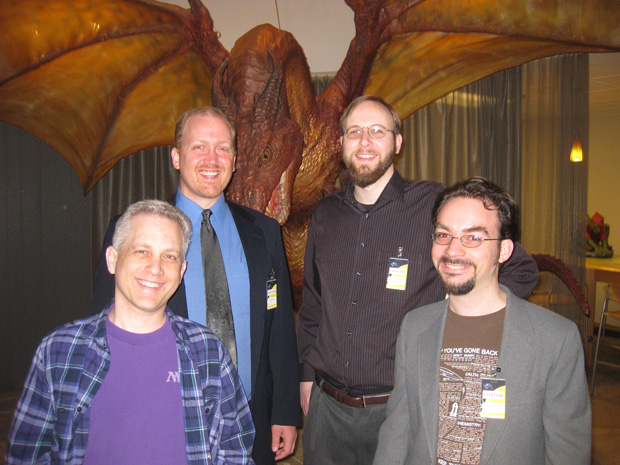
Working in an office full of game designers, there is always someone to bounce ideas off of, no matter how radical or wacky those ideas may be. If an idea might be fun and might fulfill the need of a set, it will be considered for however long it deserves. Many of our schemes cause Matt Tabak, the rules manager, some consternation (he threatens to retire on a weekly basis), but the general policy is "if it's fun, the rules can be changed to accommodate it."

Because we're all here in person, the risk of pursuing a radical idea is far less than it was during GDS2; instead of spending two weeks and risking my dream job on an idea, I'll spend an hour mocking up cards for playtesting and risk only mild ridicule. Few of these wackier ideas actually pan out, but enough of them are good enough that they make it into real sets, boggling the minds of players all over the world while still being fun. The double-faced cards in Innistrad are the most recent of these radical ideas, and I can assure you that there are more in the works.

Let's see, what other Secrets of Magic R&D can I reveal while I have this chance? How about early design? What does a card set look like in the exploratory phases, when we're trying to find out if the themes we've selected for the set will actually play properly?

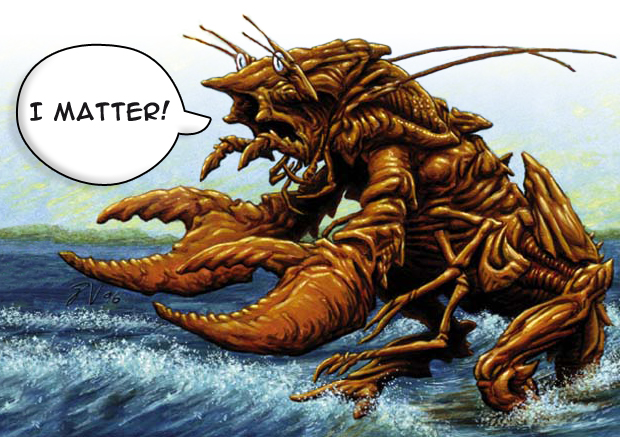
All of the sets I've worked on are still completely hush-hush, unfortunately, so I'll have to use a hypothetical example. Suppose we're doing a block code-named Maine-Lobster-Bisque. We decide that a major theme of "Lobster," the second set in the block, will be Homarids, a lobster-like creature type from early Magic. Lobster will be the "Homarids matter" set. I use this as an example because I am pretty sure it will never happen in real life. (Sorry, Homarid-lovers!)

So early in design, we'll pack the set with Homarid creature cards and spells that care about Homarids. Perhaps we would include a mechanic like this: "Lobsterstorm (If you control a Homarid when you cast this, copy this spell. You may choose another target for the copy.)" We would put tons of these types of cards in the set early on, to ensure that we encounter plenty of them each time we playtest. Some of these cards will be fun; some will make us want to put down the cards and never play Magic again. The latter will be ruthlessly excised from the set, while we will design more cards similar to the former. A set can't just hit a single note or it will get boring when people play with it month after month, so we'll incorporate more and more sub-themes as design continues, and the "Homarids matter" theme will become less and less aggressive and obvious. When we hand off the file to the development team, our themes, no matter how subtle we think they are now, will be far too overpowering for their refined palates. Sometimes only a couple of cards are enough to enable an entire deck archetype. Development is filled with masters of getting these proportions just right to maximize the set's depth for dedicated Limited players.

Speaking of Limited, almost all design playtesting is Limited playtesting. We're very interested in how the set and the block it inhabits feel. Is it fun? Is the set evoking the proper mood? Do the factions have the right personalities? Limited exposes players to the largest number of cards, especially common cards, which are the most important cards from a design perspective. As Mark stressed during the Designer Search, "if your theme doesn't appear at common, it isn't your theme."

Magic is a game that no one can ever master. It's a game with over 12,000 pieces, all of which interact with each other, and hundreds more pieces are added every three months. The practice of playing the game is always evolving, and the practice of designing the game is likewise evolving. The work that goes on at Wizards of the Coast is fun, challenging, and stimulating. And the people who work here... Did I mention that everyone I work with is brilliant? I'm still amazed, after over six months, at the diversity of different personalities, all shockingly intelligent in their own ways, that work in Magic R&D. I feel very privileged to work with them.
Scott Van Essen, left, and Ethan Fleischer, right, tower over Mark Rosewater and Shawn Main.

Several participants in GDS2 are now working here and participating in Magic design in various capacities because they recognized the same opportunity that I did. Others took a longer road, by writing articles and inventing innovative ways to play the game, by excelling in competitive Magic, or by joining Wizards in other departments and then proving their worth in the field of design. Stay alert for opportunities to do what you love. Sometimes a leap of faith will be required—I moved my wife and kids up here before I found out if there would be a position for me after the initial six months—but that leap is well worth taking. You only live once, right? And you'll never achieve greatness, in design or in life, without taking a few risks and leaving your comfort zone.